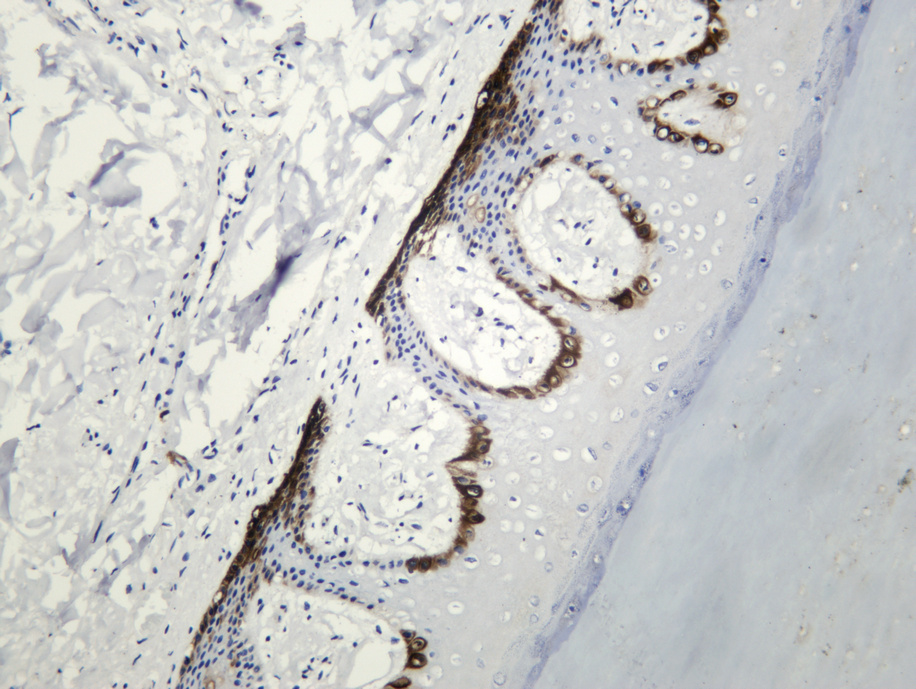
| 别名 | WNT5A;Protein Wnt-5a |
| 基因名称 | WNT5A |
| 蛋白名称 | Protein Wnt-5a |
| 推荐应用 | |
| 反应物种 | Human |
| 存储缓冲液 | PBS, 50% glycerol, 0.05% Proclin 300, 0.05%BSA |
| Human Swissprot No. | P41221 |
| Mouse Swissprot No. | P22725 |
| 特异性 | Endogenous |
| 稀释度 | IHC-P 1:200-1:1000;WB 1:2000-1:10000;IF-P/IF-F/IF-ICC 1:200-1:1000;ELISA 1:5000-1:20000; |
| 参考分子量 | 45kDa |
| 预测分子量 | 42kDa |
| 运输及保存条件 | Biological ice bag transportation. Store at -20°C for at least 12 months(Do not lower than -25°C). Avoid freeze/thaw cycles |
| 宿主 | Rabbit |
| 同种型 | IgG,Kappa |
| 背景介绍 | The WNT gene family consists of structurally related genes which encode secreted signaling proteins. These proteins have been implicated in oncogenesis and in several developmental processes, including regulation of cell fate and patterning during embryogenesis. This gene encodes a member of the WNT family that signals through both the canonical and non-canonical WNT pathways. This protein is a ligand for the seven transmembrane receptor frizzled-5 and the tyrosine kinase orphan receptor 2. This protein plays an essential role in regulating developmental pathways during embryogenesis. This protein may also play a role in oncogenesis. Mutations in this gene are the cause of autosomal dominant Robinow syndrome. Alternate splicing results in multiple transcript variants. [provided by RefSeq, Jan 2012], |
| 细胞定位 | Secreted, extracellular space, extracellular matrix . Secreted . |
| 功能 | Function:Ligand for members of the frizzled family of seven transmembrane receptors.,Function:Ligand for members of the frizzled family of seven transmembrane receptors. Can activate or inhibit canonical Wnt signaling, depending on receptor context. In the presence of FZD4, activates beta-catenin signaling. In the presence of ROR2, inhibits the canonical Wnt pathway by promoting beta-catenin degradation through a GSK3-independent pathway which involves down-regulation of beta-catenin-induced reporter gene expression. Suppression of the canonical pathway allows chondrogenesis to occur and inhibits tumor formation. Stimulates cell migration. Decreases proliferation, migration, invasiveness and clonogenicity of carcinoma cells and may act as a tumor suppressor. Mediates motility of melanoma cells. Required during embryogenesis for extension of the primary anterior-posterior axis and for outgrowth of limbs and the genital tubercle. Inhibits type II collagen expression in chondrocytes.,PTM:Glycosylation is necessary for secretion but not for activity.,PTM:Palmitoylation is necessary for stimulation of cell migration, inhibition of the beta-catenin pathway and receptor binding.,similarity:Belongs to the Wnt family.,subunit:Interacts with PORCN.,tissue specificity:Expression is increased in differentiated thyroid carcinomas compared to normal thyroid tissue and anaplastic thyroid tumors where expression is low or undetectable. Expression is found in thyrocytes but not in stromal cells (at protein level)., |
| Clonality | Monoclonal |
| 细胞定位 | Secreted, extracellular space, extracellular matrix . Secreted . |


周一至周日 8:00-18:00