

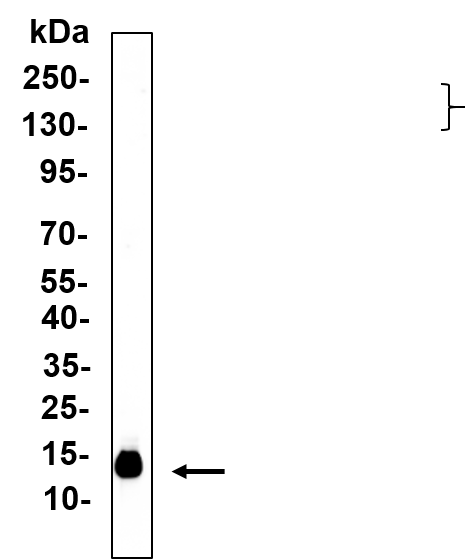
货号:GZ9215
LGALS1;Galectin-1;Gal-1;14 kDa laminin-binding protein;HLBP14;14 kDa lectin;Beta-galactoside-binding lectin L-14-I;Galaptin;HBL;HPL;Lactose-binding lectin 1;Lectin galactoside-binding soluble 1;Putative MAPK-activating protein P
| 别名 | LGALS1;Galectin-1;Gal-1;14 kDa laminin-binding protein;HLBP14;14 kDa lectin;Beta-galactoside-binding lectin L-14-I;Galaptin;HBL;HPL;Lactose-binding lectin 1;Lectin galactoside-binding soluble 1;Putative MAPK-activating protein P |
| 基因名称 | LGALS1 |
| 蛋白名称 | Galectin-1 |
| 推荐应用 | |
| 反应物种 | Human,Mouse,Rat |
| 存储缓冲液 | PBS, 50% glycerol, 0.05% Proclin 300, 0.05%BSA |
| Human Swissprot No. | P09382 |
| Mouse Swissprot No. | P16045 |
| Rat Gene ID | 56646 |
| Rat Swissprot No. | P11762 |
| 特异性 | Endogenous |
| 稀释度 | IHC-P 1:500-1:2000, WB 1:2000-1:10000, IF 1:200-1:1000, ELISA 1:5000-1:20000, IP 1:50-1:200 |
| 参考分子量 | 15kDa |
| 预测分子量 | 15kDa |
| 运输及保存条件 | Biological ice bag transportation. Store at -20°C for at least 12 months(Do not lower than -25°C). Avoid freeze/thaw cycles |
| 宿主 | Rabbit |
| 同种型 | IgG,Kappa |
| 背景介绍 | The galectins are a family of beta-galactoside-binding proteins implicated in modulating cell-cell and cell-matrix interactions. This gene product may act as an autocrine negative growth factor that regulates cell proliferation. [provided by RefSeq, Jul 2008], |
| 细胞定位 | Secreted, extracellular space, extracellular matrix . Cytoplasm . Secreted . Can be secreted; the secretion is dependent on protein unfolding and facilitated by the cargo receptor TMED10; it results in protein translocation from the cytoplasm into the ERGIC (endoplasmic reticulum-Golgi intermediate compartment) followed by vesicle entry and secretion. . |
| Clonality | Monoclonal |
| 细胞定位 | Secreted, extracellular space, extracellular matrix . Cytoplasm . Secreted . Can be secreted; the secretion is dependent on protein unfolding and facilitated by the cargo receptor TMED10; it results in protein translocation from the cytoplasm into the ERGIC (endoplasmic reticulum-Golgi intermediate compartment) followed by vesicle entry and secretion. . |


周一至周日 8:00-18:00
