| 别名 | Nuclear factor of activated T-cells, cytoplasmic 2;NF-ATc2;NFATc2;NFAT pre-existing subunit;NF-ATp;T-cell transcription factor NFAT1;NFAT1;NFATP |
| 基因名称 | NFATC2 |
| 蛋白名称 | Nuclear factor of activated T-cells, cytoplasmic 2 (NF-ATc2) (NFATc2) (NFAT pre-existing subunit) (NF-ATp) (T-cell transcription factor NFAT1) |
| 推荐应用 | |
| 反应物种 | Human |
| 存储缓冲液 | PBS, 50% glycerol, 0.05% Proclin 300, 0.05%BSA |
| Human Swissprot No. | Q13469 |
| Mouse Gene ID | 18019 |
| Mouse Swissprot No. | Q60591 |
| 特异性 | Endogenous |
| 稀释度 | IHC-P 1:100-1:500, WB 1:2000-1:10000, IF-P/IF-F/IF-ICC 1:200-1:1000, ELISA 1:5000-1:20000 |
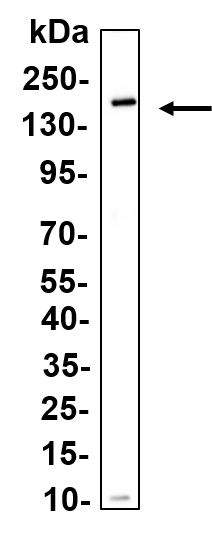
| 参考分子量 | 140kDa |
| 预测分子量 | 100kDa |
| 运输及保存条件 | Biological ice bag transportation. Store at -20°C for at least 12 months(Do not lower than -25°C). Avoid freeze/thaw cycles |
| 宿主 | Rabbit |
| 同种型 | IgG,Kappa |
| 背景介绍 | This gene is a member of the nuclear factor of activated T cells (NFAT) family. The product of this gene is a DNA-binding protein with a REL-homology region (RHR) and an NFAT-homology region (NHR). This protein is present in the cytosol and only translocates to the nucleus upon T cell receptor (TCR) stimulation, where it becomes a member of the nuclear factors of activated T cells transcription complex. This complex plays a central role in inducing gene transcription during the immune response. Alternate transcriptional splice variants encoding different isoforms have been characterized. [provided by RefSeq, Apr 2012], |
| 细胞定位 | Cytoplasm. Nucleus. Cytoplasmic for the phosphorylated form and nuclear after activation that is controlled by calcineurin-mediated dephosphorylation. Rapid nuclear exit of NFATC is thought to be one mechanism by which cells distinguish between sustained and transient calcium signals. The subcellular localization of NFATC plays a key role in the regulation of gene transcription. |
| 纯化 | Protein A |
| Clonality | Monoclonal |
| 细胞定位 | Cytoplasm. Nucleus. Cytoplasmic for the phosphorylated form and nuclear after activation that is controlled by calcineurin-mediated dephosphorylation. Rapid nuclear exit of NFATC is thought to be one mechanism by which cells distinguish between sustained and transient calcium signals. The subcellular localization of NFATC plays a key role in the regulation of gene transcription. |


周一至周日 8:00-18:00