| 别名 | EP300;P300;Histone acetyltransferase p300;p300 HAT;E1A-associated protein p300 |
| 基因名称 | EP300 |
| 蛋白名称 | Histone acetyltransferase p300 |
| 推荐应用 | |
| 反应物种 | Human,Mouse,Rat |
| 存储缓冲液 | PBS, 50% glycerol, 0.05% Proclin 300, 0.05%BSA |
| Human Swissprot No. | Q09472 |
| Mouse Swissprot No. | B2RWS6 |
| 特异性 | Endogenous |
| 稀释度 | WB 1:2000-1:10000, IF-P/IF-F/IF-ICC 1:200-1:1000, ELISA 1:5000-1:20000, IP 1:50-1:200, |
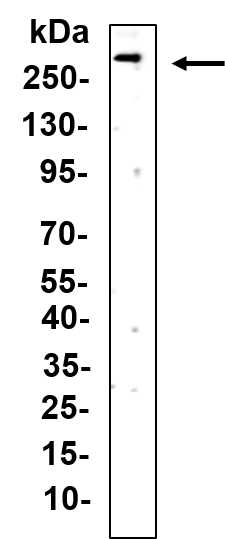
| 参考分子量 | 300kDa |
| 预测分子量 | 264kDa |
| 运输及保存条件 | Biological ice bag transportation. Store at -20°C for at least 12 months(Do not lower than -25°C). Avoid freeze/thaw cycles |
| 宿主 | Rabbit |
| 同种型 | IgG,Kappa |
| 背景介绍 | E1A binding protein p300(EP300) Homo sapiens This gene encodes the adenovirus E1A-associated cellular p300 transcriptional co-activator protein. It functions as histone acetyltransferase that regulates transcription via chromatin remodeling and is important in the processes of cell proliferation and differentiation. It mediates cAMP-gene regulation by binding specifically to phosphorylated CREB protein. This gene has also been identified as a co-activator of HIF1A (hypoxia-inducible factor 1 alpha), and thus plays a role in the stimulation of hypoxia-induced genes such as VEGF. Defects in this gene are a cause of Rubinstein-Taybi syndrome and may also play a role in epithelial cancer. [provided by RefSeq, Jul 2008], |
| 细胞定位 | Cytoplasm . Nucleus . Chromosome . Localizes to active chromatin: Colocalizes with histone H3 acetylated and/or crotonylated at 'Lys-18' (H3K18ac and H3K18cr, respectively) (PubMed:25818647). In the presence of ALX1 relocalizes from the cytoplasm to the nucleus. Colocalizes with ROCK2 in the nucleus (PubMed:12929931). . |
| 纯化 | Protein A |
| Clonality | Monoclonal |
| 细胞定位 | Cytoplasm . Nucleus . Chromosome . Localizes to active chromatin: Colocalizes with histone H3 acetylated and/or crotonylated at 'Lys-18' (H3K18ac and H3K18cr, respectively) (PubMed:25818647). In the presence of ALX1 relocalizes from the cytoplasm to the nucleus. Colocalizes with ROCK2 in the nucleus (PubMed:12929931). . |


周一至周日 8:00-18:00