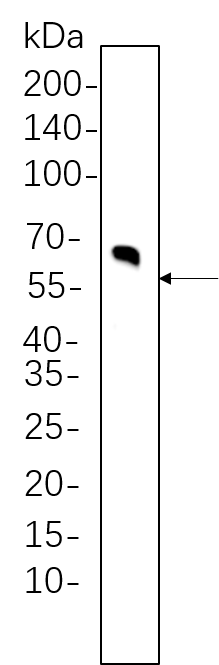
| 别名 | Tyrosine 3-monooxygenase;Tyrosine 3-hydroxylase;TH;TYH |
| 基因名称 | TH |
| 蛋白名称 | Tyrosine 3-monooxygenase (Tyrosine 3-hydroxylase) (TH),Tyrosine Hydrolase |
| 推荐应用 | |
| 反应物种 | Human,Mouse,Rat |
| 存储缓冲液 | PBS, 50% glycerol, 0.05% Proclin 300, 0.05%BSA |
| Human Swissprot No. | P07101 |
| Mouse Gene ID | 21823 |
| Mouse Swissprot No. | P24529 |
| Rat Gene ID | 25085 |
| Rat Swissprot No. | P04177 |
| 特异性 | Endogenous |
| 稀释度 | IHC-P 1:500-1:2000, WB 1:2000-1:10000, IF-P/IF-F/IF-ICC 1:200-1:1000, ELISA 1:5000-1:20000 |
| 参考分子量 | 59kDa |
| 预测分子量 | 59kDa |
| 运输及保存条件 | Biological ice bag transportation. Store at -20°C for at least 12 months(Do not lower than -25°C). Avoid freeze/thaw cycles |
| 宿主 | Rabbit |
| 同种型 | IgG,Kappa |
| 背景介绍 | The protein encoded by this gene is involved in the conversion of tyrosine to dopamine. It is the rate-limiting enzyme in the synthesis of catecholamines, hence plays a key role in the physiology of adrenergic neurons. Mutations in this gene have been associated with autosomal recessive Segawa syndrome. Alternatively spliced transcript variants encoding different isoforms have been noted for this gene. [provided by RefSeq, Jul 2008], |
| 功能 | Catalytic activity:L-tyrosine + tetrahydrobiopterin + O(2) = 3,4-dihydroxy-L-phenylalanine + 4a-hydroxytetrahydrobiopterin.,cofactor:Fe(2+) ion.,Disease:Defects in TH are the cause of dystonia DOPA-responsive autosomal recessive (ARDRD) [MIM:605407]; also known as autosomal recessive Segawa syndrome. ARDRD is a form of DOPA-responsive dystonia presenting in infancy or early childhood. Dystonia is defined by the presence of sustained involuntary muscle contractions, often leading to abnormal postures. Some cases of ARDRD present with parkinsonian symptoms in infancy. Unlike all other forms of dystonia, it is an eminently treatable condition, due to a favorable response to L-DOPA.,enzyme regulation:Phosphorylation leads to an increase in the catalytic activity.,Function:Plays an important role in the physiology of adrenergic neurons.,online information:Tyrosine hydroxylase entry,pathway:Catecholamine biosynthesis; dopamine biosynthesis; dopamine from L-tyrosine: step 1/2.,similarity:Belongs to the biopterin-dependent aromatic amino acid hydroxylase family.,tissue specificity:Mainly expressed in the brain and adrenal glands., |
| 纯化 | Protein A |
| Clonality | Monoclonal |


周一至周日 8:00-18:00