

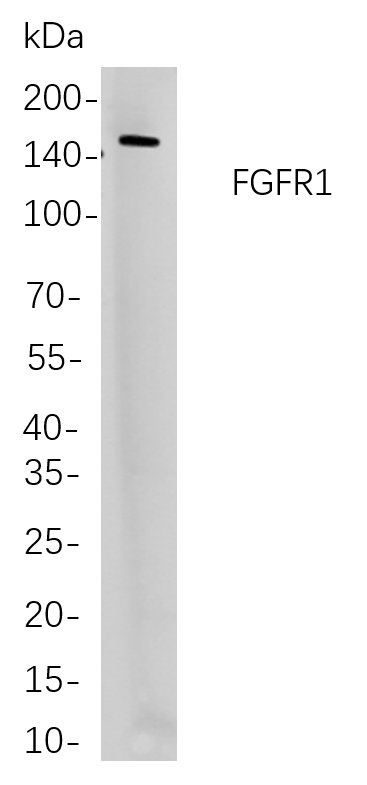
货号:GZ8271
FGFR1;BFGFR;CEK;FGFBR;FLG;FLT2;HBGFR;Fibroblast growth factor receptor 1;FGFR-1;Basic fibroblast growth factor receptor 1;BFGFR;bFGF-R-1;Fms-like tyrosine kinase 2;FLT-2;N-sam;Proto-oncogene c-Fgr;CD antigen CD331;BFGFR;CEK;FGFBR;FLG;FLT2;HBGFR;
| 别名 | FGFR1;BFGFR;CEK;FGFBR;FLG;FLT2;HBGFR;Fibroblast growth factor receptor 1;FGFR-1;Basic fibroblast growth factor receptor 1;BFGFR;bFGF-R-1;Fms-like tyrosine kinase 2;FLT-2;N-sam;Proto-oncogene c-Fgr;CD antigen CD331;BFGFR;CEK;FGFBR;FLG;FLT2;HBGFR; |
| 基因名称 | FGFR1 |
| 蛋白名称 | Fibroblast growth factor receptor 1 |
| 推荐应用 | |
| 反应物种 | Human |
| 存储缓冲液 | PBS, 50% glycerol, 0.05% Proclin 300, 0.05%BSA |
| Human Gene Link | http://www.ncbi.nlm.nih.gov/sites/entrez?db=gene&term=2260 |
| Human Swissprot No. | P11362 |
| Human Swissprot Link | http://www.uniprot.org/uniprotkb/P11362/entry |
| Mouse Gene ID | 14182 |
| Mouse Gene Link | http://www.ncbi.nlm.nih.gov/sites/entrez?db=gene&term=14182 |
| Mouse Swissprot No. | P16092 |
| Mouse Swissprot Link | http://www.uniprot.org/uniprot/P16092 |
| Rat Gene ID | 79114 |
| Rat Gene Link | http://www.ncbi.nlm.nih.gov/sites/entrez?db=gene&term=79114 |
| Rat Swissprot No. | Q04589 |
| Rat Swissprot Link | http://www.uniprot.org/uniprot/Q04589 |
| 稀释度 | IHC-P 1:100-200,WB 1:500-2000,IF-P/IF-F/IF-ICC 1:200-1000,ELISA 1:5000-20000,IP 1:50-200 |
| 参考分子量 | 145kDa |
| 预测分子量 | 91kDa |
| 运输及保存条件 | Biological ice bag transportation. Store at -20°C for at least 12 months(Do not lower than -25°C). Avoid freeze/thaw cycles |
| 宿主 | Rabbit |
| 同种型 | Monoclonal, rabbit, IgG, Kappa |
| 背景介绍 | The protein encoded by this gene is a member of the fibroblast growth factor receptor (FGFR) family, where amino acid sequence is highly conserved between members and throughout evolution. FGFR family members differ from one another in their ligand affinities and tissue distribution. A full-length representative protein consists of an extracellular region, composed of three immunoglobulin-like domains, a single hydrophobic membrane-spanning segment and a cytoplasmic tyrosine kinase domain. The extracellular portion of the protein interacts with fibroblast growth factors, setting in motion a cascade of downstream signals, ultimately influencing mitogenesis and differentiation. This particular family member binds both acidic and basic fibroblast growth factors and is involved in limb induction. Mutations in this gene have been associated with Pfeiffer syndrome, Jackson-Weiss syndrome, |
| 信号通路 | MAPK_ERK_Growth;MAPK_G_Protein;Adherens_Junction;Regulates Actin and Cytoskeleton;Pathways in cancer;Prostate cancer;Melanoma; |
| 功能 | catalytic activity:ATP + a [protein]-L-tyrosine = ADP + a [protein]-L-tyrosine phosphate.,disease:A chromosomal aberration involving FGFR1 may be a cause of stem cell leukemia lymphoma syndrome (SCLL). Translocation t(8;13)(p11;q12) with ZMYM2. SCLL usually presents as lymphoblastic lymphoma in association with a myeloproliferative disorder, often accompanied by pronounced peripheral eosinophilia and/or prominent eosinophilic infiltrates in the affected bone marrow.,disease:A chromosomal aberration involving FGFR1 may be a cause of stem cell myeloproliferative disorder (MPD). Translocation t(6;8)(q27;p11) with FGFR1OP. Insertion ins(12;8)(p11;p11p22) with FGFR1OP2. MPD is characterized by myeloid hyperplasia, eosinophilia and T-cell or B-cell lymphoblastic lymphoma. In general it progresses to acute myeloid leukemia. The fusion proteins FGFR1OP2-FGFR1, FGFR1OP-FGFR1 or FGFR1-FGFR1OP may exhibit constitutive kinase activity and be responsible for the transforming activity.,disease:A chromosomal aberration involving FGFR1 may be a cause of stem cell myeloproliferative disorder (MPD). Translocation t(8;9)(p12;q33) with CEP110. MPD is characterized by myeloid hyperplasia, eosinophilia and T-cell or B-cell lymphoblastic lymphoma. In general it progresses to acute myeloid leukemia. The fusion protein CEP110-FGFR1 is found in the cytoplasm, exhibits constitutive kinase activity and may be responsible for the transforming activity.,disease:Defects in FGFR1 are a cause of idiopathic hypogonadotropic hypogonadism (IHH) [MIM:146110]. IHH is defined as a deficiency of the pituitary secretion of follicle-stimulating hormone and luteinizing hormone, which results in the impairment of pubertal maturation and of reproductive function.,disease:Defects in FGFR1 are a cause of Pfeiffer syndrome (PS) [MIM:101600]; also known as acrocephalosyndactyly type V (ACS5). PS is characterized by craniosynostosis (premature fusion of the skull sutures) with deviation and enlargement of the thumbs and great toes, brachymesophalangy, with phalangeal ankylosis and a varying degree of soft tissue syndactyly.,disease:Defects in FGFR1 are the cause of Kallmann syndrome type 2 (KAL2) [MIM:147950]; also known as hypogonadotropic hypogonadism and anosmia. Anosmia or hyposmia is related to the absence or hypoplasia of the olfactory bulbs and tracts. Hypogonadism is due to deficiency in gonadotropin-releasing hormone and probably results from a failure of embryonic migration of gonadotropin-releasing hormone-synthesizing neurons. In some cases, midline cranial anomalies (cleft lip/palate and imperfect fusion) are present and anosmia may be absent or inconspicuous.,disease:Defects in FGFR1 are the cause of non-syndromic trigonocephaly [MIM:190440]; also known as metopic craniosynostosis. The term trigonocephaly describes the typical keel-shaped deformation of the forehead resulting from premature fusion of the frontal suture. Trigonocephaly may occur also as a part of a syndrome.,disease:Defects in FGFR1 are the cause of osteoglophonic dysplasia (OGD) [MIM:166250]; also known as osteoglophonic dwarfism. OGD is characterized by craniosynostosis, prominent supraorbital ridge, and depressed nasal bridge, as well as by rhizomelic dwarfism and nonossifying bone lesions. Inheritance is autosomal dominant.,function:Receptor for basic fibroblast growth factor. A shorter form of the receptor could be a receptor for FGF1 (aFGF).,PTM:Binding of FGF1 and heparin promotes autophosphorylation on tyrosine residues and activation of the receptor.,similarity:Belongs to the protein kinase superfamily. Tyr protein kinase family.,similarity:Belongs to the protein kinase superfamily. Tyr protein kinase family. Fibroblast growth factor receptor subfamily.,similarity:Contains 1 protein kinase domain.,similarity:Contains 3 Ig-like C2-type (immunoglobulin-like) domains.,subunit:Interacts with SHB. Interacts with KLB., |
| 纯化 | Protein A |
| Clonality | Monoclonal |


周一至周日 8:00-18:00
