| 别名 | SLC25A7;UCP |
| 基因名称 | UCP1 |
| 蛋白名称 | Mitochondrial brown fat uncoupling protein 1 (UCP 1) (Solute carrier family 25 member 7) (Thermogenin) |
| 推荐应用 | |
| 反应物种 | Mouse,Rat |
| 存储缓冲液 | PBS, 50% glycerol, 0.05% Proclin 300, 0.05%BSA |
| Human Gene Link | http://www.ncbi.nlm.nih.gov/sites/entrez?db=gene&term=7350 |
| Human Swissprot No. | P25874 |
| Human Swissprot Link | https://www.uniprot.org/uniprotkb/P25874/entry |
| Mouse Swissprot No. | P12242 |
| Mouse Swissprot Link | http://www.uniprot.org/uniprot/P12242 |
| Rat Swissprot No. | P04633 |
| Rat Swissprot Link | http://www.uniprot.org/uniprot/O54941P04633 |
| 稀释度 | IHC-P 1:200-1000,WB 1:1000-5000,IF-P/IF-F/IF-ICC 1:200-1000,ELISA 1:5000-20000,IP 1:50-200 |
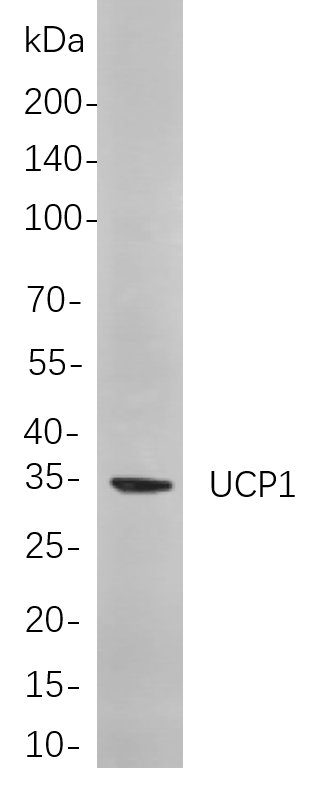
| 参考分子量 | 33kDa |
| 预测分子量 | 33kDa |
| 运输及保存条件 | Biological ice bag transportation. Store at -20°C for at least 12 months(Do not lower than -25°C). Avoid freeze/thaw cycles |
| 宿主 | Rabbit |
| 同种型 | Monoclonal, rabbit, IgG, Kappa |
| 背景介绍 | Mitochondrial uncoupling proteins (UCP) are members of the family of mitochondrial anion carrier proteins (MACP). UCPs separate oxidative phosphorylation from ATP synthesis with energy dissipated as heat, also referred to as the mitochondrial proton leak. UCPs facilitate the transfer of anions from the inner to the outer mitochondrial membrane and the return transfer of protons from the outer to the inner mitochondrial membrane. They also reduce the mitochondrial membrane potential in mammalian cells. Tissue specificity occurs for the different UCPs and the exact methods of how UCPs transfer H+/OH- are not known. UCPs contain the three homologous protein domains of MACPs. This gene is expressed only in brown adipose tissue, a specialized tissue which functions to produce heat. [provided by RefSeq, Jul 2008], |
| 信号通路 | PPAR;Huntington's disease; |
| 功能 | function:UCP are mitochondrial transporter proteins that create proton leaks across the inner mitochondrial membrane, thus uncoupling oxidative phosphorylation from ATP synthesis. As a result, energy is dissipated in the form of heat.,polymorphism:The Thr-64 polymorphism is associated with an increased waist-to-hip ratio. The Leu-229 polymorphism is associated with susceptibility to type II diabetes mellitus.,similarity:Belongs to the mitochondrial carrier family.,similarity:Contains 3 Solcar repeats.,subunit:Acts as a dimer forming a proton channel.,tissue specificity:Brown adipose tissue., |
| 纯化 | Protein A |
| Clonality | Monoclonal |


周一至周日 8:00-18:00