

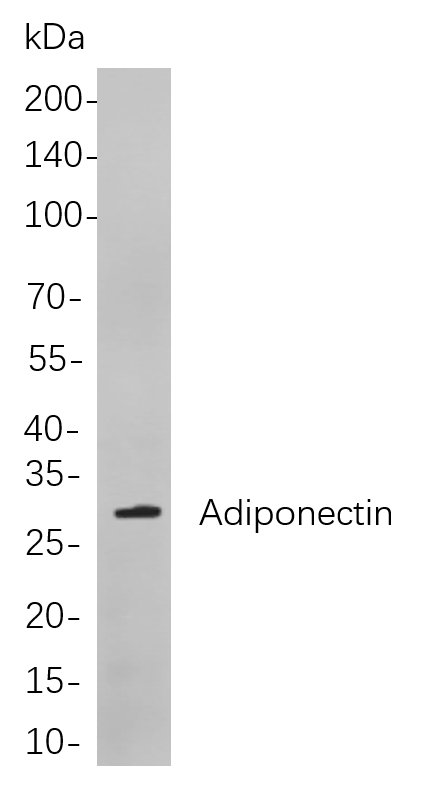
货号:GZ8146
ADIPOQ;ACDC;ACRP30;APM1;GBP28;Adiponectin;30 kDa adipocyte complement-related protein;Adipocyte complement-related 30 kDa protein;ACRP30;Adipocyte; C1q and collagen domain-containing protein;Adipose most abundant gene transcript 1
| 别名 | ADIPOQ;ACDC;ACRP30;APM1;GBP28;Adiponectin;30 kDa adipocyte complement-related protein;Adipocyte complement-related 30 kDa protein;ACRP30;Adipocyte; C1q and collagen domain-containing protein;Adipose most abundant gene transcript 1 |
| 基因名称 | ADIPOQ |
| 蛋白名称 | Adiponectin |
| 推荐应用 | |
| 反应物种 | Human,Mouse,Rat |
| 存储缓冲液 | PBS, 50% glycerol, 0.05% Proclin 300, 0.05%BSA |
| Human Gene Link | http://www.ncbi.nlm.nih.gov/sites/entrez?db=gene&term=9370 |
| Human Swissprot No. | Q15848 |
| Human Swissprot Link | http://www.uniprot.org/uniprotkb/Q15848/entry |
| Mouse Gene ID | 11450 |
| Mouse Gene Link | http://www.ncbi.nlm.nih.gov/sites/entrez?db=gene&term=11450 |
| Mouse Swissprot No. | Q60994 |
| Mouse Swissprot Link | http://www.uniprot.org/uniprot/Q60994 |
| 稀释度 | IHC-P 1:1000-1:4000, WB 1:1000-1:5000, IF-P/IF-F/IF-ICC 1:200-1:1000, ELISA 1:5000-1:20000, IP 1:50-1:200 |
| 参考分子量 | 30kDa |
| 预测分子量 | 26kDa |
| 运输及保存条件 | Biological ice bag transportation. Store at -20°C for at least 12 months(Do not lower than -25°C). Avoid freeze/thaw cycles |
| 宿主 | Rabbit |
| 同种型 | Monoclonal, rabbit, IgG, Kappa |
| 背景介绍 | adiponectin, C1Q and collagen domain containing(ADIPOQ) Homo sapiens This gene is expressed in adipose tissue exclusively. It encodes a protein with similarity to collagens X and VIII and complement factor C1q. The encoded protein circulates in the plasma and is involved with metabolic and hormonal processes. Mutations in this gene are associated with adiponectin deficiency. Multiple alternatively spliced variants, encoding the same protein, have been identified. [provided by RefSeq, Apr 2010], |
| 功能 | disease:Defects in ADIPOQ are the cause of adiponectin deficiency (ADPND) [MIM:612556]. ADPND results in very low concentrations of plasma adiponectin.,disease:Genetic variations in ADIPOQ are associated with non-insulin-dependent diabetes mellitus (NIDDM) [MIM:125853]; also known as diabetes mellitus type 2. NIDDM is characterized by an autosomal dominant mode of inheritance, onset during adulthood and insulin resistance.,domain:The C1q domain is commonly called the globular domain.,function:Important adipokine involved in the control of fat metabolism and insulin sensitivity, with direct anti-diabetic, anti-atherogenic and anti-inflammatory activities. Stimulates AMPK phosphorylation and activation in the liver and the skeletal muscle, enhancing glucose utilization and fatty-acid combustion. Antagonizes TNF-alpha by negatively regulating its expression in various tissues such as liver and macrophages, and also by counteracting its effects. Inhibits endothelial NF-kappa-B signaling through a cAMP-dependent pathway. May play a role in cell growth, angiogenesis and tissue remodeling by binding and sequestering various growth factors with distinct binding affinities, depending on the type of complex, LMW, MMW or HMW.,miscellaneous:HMW-complex blood contents are higher in females than in males, are increased in males by castration and decreased again upon subsequent testosterone treatment, which blocks HMW-complex secretion (By similarity). In type 2 diabetic patients, both the ratios of HMW to total adiponectin and the degree of adiponectin glycosylation are significantly decreased as compared with healthy controls.,miscellaneous:Variants Arg-84 and Ser-90 show impaired formation of HMW complexes whereas variants Cys-112 and Thr-164 show impaired secretion of adiponectin in any form.,online information:Adiponectin entry,pharmaceutical:Adiponectin might be used in the treatment of diabetes type 2 and insulin resistance.,polymorphism:Genetic variations in ADIPOQ influence the variance in adiponectin serum levels and define the adiponectin serum levels quantitative trait locus 1 (ADIPQTL1) [MIM:612556].,PTM:HMW complexes are more extensively glycosylated than smaller oligomers. Hydroxylation and glycosylation of the lysine residues within the collagene-like domain of adiponectin seem to be critically involved in regulating the formation and/or secretion of HMW complexes and consequently contribute to the insulin-sensitizing activity of adiponectin in hepatocytes.,PTM:Hydroxylated Lys-33 was not identified in PubMed:16497731, probably due to poor representation of the N-terminal peptide in mass fingerprinting.,PTM:Not N-glycosylated.,PTM:O-linked glycans consist of Glc-Gal disaccharides bound to the oxygen atom of post-translationally added hydroxyl groups.,similarity:Contains 1 C1q domain.,similarity:Contains 1 collagen-like domain.,subunit:Homomultimer. Forms trimers, hexamers and 12- to 18-mers. The trimers (low molecular weight complexes / LMW) are assembled via non-covalent interactions of the collagen-like domains in a triple helix and hydrophobic interactions within the globular C1q domain. Several trimers can associate to form disulfide-linked hexamers (middle molecular weight complexes / MMW) and larger complexes (higher molecular weight / HMW). The HMW-complex assembly may rely aditionnally on lysine hydroxylation and glycosylation. LMW, MMW and HMW complexes bind to HBEGF, MMW and HMW complexes bind to PDGFB, and HMW complex binds to FGF2.,tissue specificity:Synthesized exclusively by adipocytes and secreted into plasma., |
| 纯化 | Protein A |
| Clonality | Monoclonal |


周一至周日 8:00-18:00
