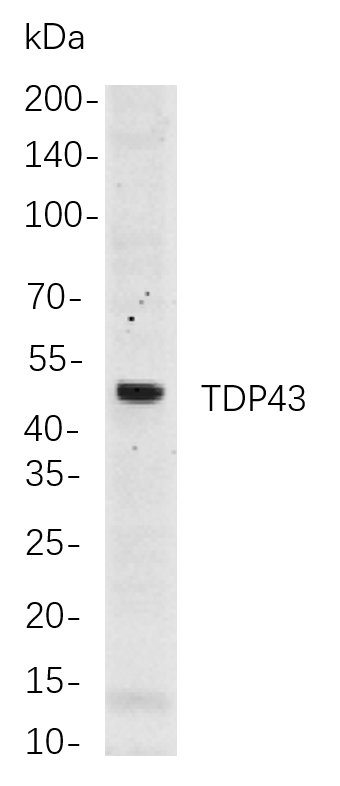
| 别名 | TDP43 |
| 基因名称 | TARDBP |
| 蛋白名称 | TAR DNA-binding protein 43 (TDP-43) |
| 推荐应用 | |
| 反应物种 | Human,Mouse,Rat |
| 存储缓冲液 | PBS, 50% glycerol, 0.05% Proclin 300, 0.05%BSA |
| Human Gene Link | http://www.ncbi.nlm.nih.gov/sites/entrez?db=gene&term=23435 |
| Human Swissprot No. | Q13148 |
| Human Swissprot Link | https://www.uniprot.org/uniprotkb/Q13148/entry |
| Mouse Swissprot No. | Q921F2 |
| Mouse Swissprot Link | http://www.uniprot.org/uniprot/Q921F2 |
| 稀释度 | IHC-P 1:200-1:1000,WB 1:1000-1:5000,IF-P/IF-F/IF-ICC 1:200-1:1000,ELISA 1:5000-1:20000,IP 1:50-1:200 |
| 参考分子量 | 45kDa |
| 预测分子量 | 45kDa |
| 运输及保存条件 | Biological ice bag transportation. Store at -20°C for at least 12 months(Do not lower than -25°C). Avoid freeze/thaw cycles |
| 宿主 | Rabbit |
| 同种型 | Monoclonal, rabbit, IgG, Kappa |
| 背景介绍 | TAR DNA binding protein(TARDBP) Homo sapiens HIV-1, the causative agent of acquired immunodeficiency syndrome (AIDS), contains an RNA genome that produces a chromosomally integrated DNA during the replicative cycle. Activation of HIV-1 gene expression by the transactivator Tat is dependent on an RNA regulatory element (TAR) located downstream of the transcription initiation site. The protein encoded by this gene is a transcriptional repressor that binds to chromosomally integrated TAR DNA and represses HIV-1 transcription. In addition, this protein regulates alternate splicing of the CFTR gene. A similar pseudogene is present on chromosome 20. [provided by RefSeq, Jul 2008], |
| 功能 | disease:Defects in TARDBP are a cause of amyotrophic lateral sclerosis type 10 (ALS10) [MIM:612069]. ALS is a neurodegenerative disorder affecting upper and lower motor neurons and resulting in fatal paralysis. Sensory abnormalities are absent. Death usually occurs within 2 to 5 years. The etiology of ALS is likely to be multifactorial, involving both genetic and environmental factors. TARDBP is the primary component of ubiquitin-positive inclusion bodies found in ALS and in frontotemporal lobar degeneration with ubiquitin-positive inclusions (FTLDU).,function:DNA and RNA-binding protein which regulates transcription and splicing. Involved in the regulation of CFTR splicing. It promotes CFTR exon 9 skipping by binding to the UG repeated motifs in the polymorphic region near the 3'-splice site of this exon. The resulting aberrant splicing is associated with pathological features typical of cystic fibrosis. May also be involved in microRNA biogenesis, apoptosis and cell division. Can repress HIV-1 transcription by binding to the HIV-1 long terminal repeat.,PTM:Cleaved to generate C-terminal fragments in hippocampus, neocortex, and spinal cord from individuals affected with ALS and FTLDU.,PTM:Hyperphosphorylated in hippocampus, neocortex, and spinal cord from individuals affected with ALS and FTLDU.,PTM:Ubiquitinated in hippocampus, neocortex, and spinal cord from individuals affected with ALS and FTLDU.,similarity:Contains 2 RRM (RNA recognition motif) domains.,subcellular location:Eliminated from nuclei of ubiquitinated inclusion-bearing neurons in FTLDU.,subunit:Binds specifically to pyrimidine-rich motifs of TAR DNA and to single stranded TG repeated sequences. Binds to RNA, specifically to UG repeated sequences with a minimun of six contiguous repeats.,tissue specificity:Ubiquitously expressed. In particular, expression is high in pancreas, placenta, lung, genital tract and spleen., |
| 纯化 | Protein A |
| Clonality | Monoclonal |


周一至周日 8:00-18:00