| 别名 | Transforming growth factor beta-1 (TGF-beta-1) [Cleaved into: Latency-associated peptide (LAP)];TGFB |
| 基因名称 | TGFB1 |
| 蛋白名称 | Transforming growth factor beta-1 (TGF-beta-1) [Cleaved into: Latency-associated peptide (LAP)] |
| 推荐应用 | |
| 反应物种 | Human,Mouse,Rat |
| 存储缓冲液 | PBS, 50% glycerol, 0.05% Proclin 300, 0.05%BSA |
| Human Gene Link | http://www.ncbi.nlm.nih.gov/sites/entrez?db=gene&term=7040 |
| Human Swissprot No. | P01137 |
| Human Swissprot Link | https://www.uniprot.org/uniprotkb/P01137/entry |
| Mouse Gene ID | 21803 |
| Mouse Gene Link | http://www.ncbi.nlm.nih.gov/sites/entrez?db=gene&term=21803 |
| Mouse Swissprot No. | P04202 |
| Mouse Swissprot Link | https://www.uniprot.org/uniprotkb/P04202/entry |
| Rat Gene ID | 59086 |
| Rat Gene Link | http://www.ncbi.nlm.nih.gov/sites/entrez?db=gene&term=59086 |
| Rat Swissprot No. | P17246 |
| Rat Swissprot Link | https://www.uniprot.org/uniprotkb/P17246/entry |
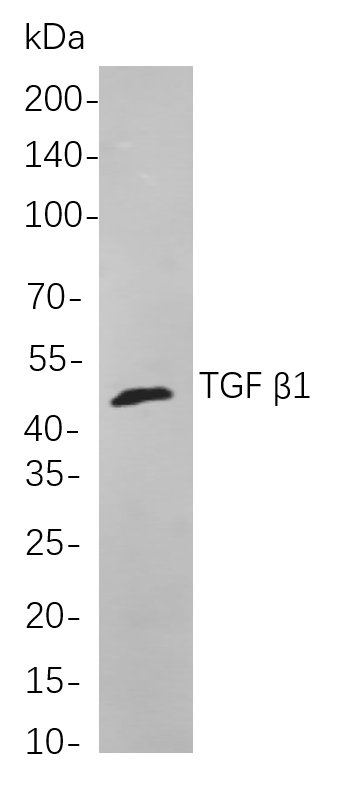
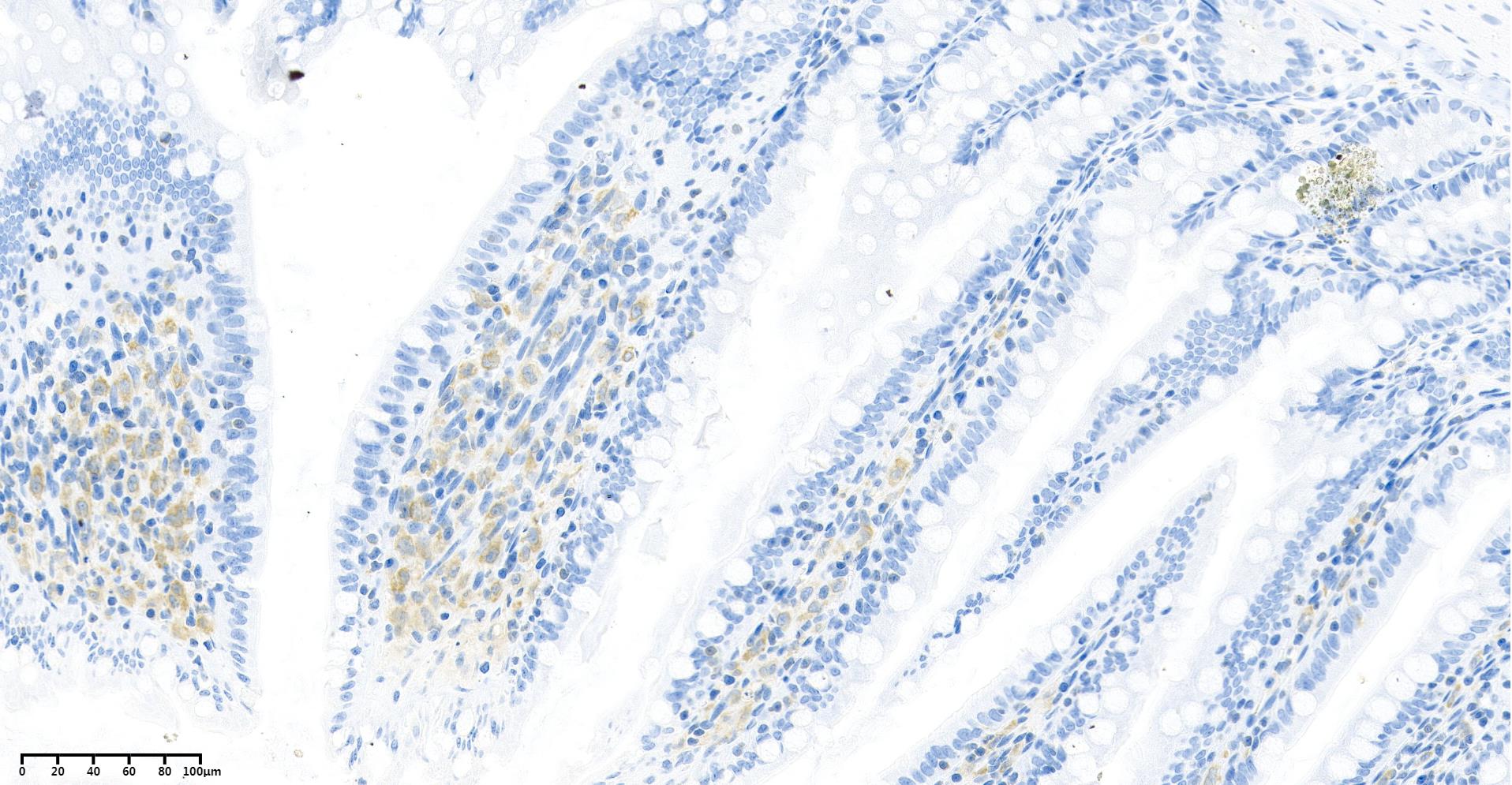
| 稀释度 | IHC-P 1:2000-1:5000, WB 1:1000-1:5000, IF-P/IF-F/IF-ICC 1:200-1:1000, ELISA 1:5000-1:20000 |
| 参考分子量 | 44kDa,13kDa |
| 预测分子量 | 44kDa |
| 运输及保存条件 | Biological ice bag transportation. Store at -20°C for at least 12 months(Do not lower than -25°C). Avoid freeze/thaw cycles |
| 宿主 | Rabbit |
| 同种型 | Monoclonal, rabbit, IgG, Kappa |
| 背景介绍 | transforming growth factor beta 1(TGFB1) Homo sapiens This gene encodes a secreted ligand of the TGF-beta (transforming growth factor-beta) superfamily of proteins. Ligands of this family bind various TGF-beta receptors leading to recruitment and activation of SMAD family transcription factors that regulate gene expression. The encoded preproprotein is proteolytically processed to generate a latency-associated peptide (LAP) and a mature peptide, and is found in either a latent form composed of a mature peptide homodimer, a LAP homodimer, and a latent TGF-beta binding protein, or in an active form consisting solely of the mature peptide homodimer. The mature peptide may also form heterodimers with other TGFB family members. This encoded protein regulates cell proliferation, differentiation and growth, and can modulate expression and activation of other growth factors including interferon gamma and tumor necrosis factor alpha. This gene i |
| 功能 | disease:Defects in TGFB1 are the cause of Camurati-Engelmann disease (CED) [MIM:131300]; also known as progressive diaphyseal dysplasia 1 (DPD1). CED is an autosomal dominant disorder characterized by hyperostosis and sclerosis of the diaphyses of long bones. The disease typically presents in early childhood with pain, muscular weakness and waddling gait, and in some cases other features such as exophthalmos, facial paralysis, hearing difficulties and loss of vision.,function:Multifunctional protein that controls proliferation, differentiation and other functions in many cell types. Many cells synthesize TGFB1 and have specific receptors for it. It positively and negatively regulates many other growth factors. It plays an important role in bone remodeling as it is a potent stimulator of osteoblastic bone formation, causing chemotaxis, proliferation and differentiation in committed osteoblasts.,induction:Activated in vitro at pH below 3.5 and over 12.5.,online information:TGF beta-1 entry,polymorphism:In post-menopausal Japanese women, the frequency of Leu-10 is higher in subjects with osteoporosis than in controls.,PTM:Glycosylated.,PTM:The precursor is cleaved into mature TGF-beta-1 and LAP, which remains non-covalently linked to mature TGF-beta-1 rendering it inactive.,similarity:Belongs to the TGF-beta family.,subunit:The inactive form consists of a TGFB1 homodimer non-covalently linked to a latency-associated peptide (LAP) homodimer. The inactive complex can contain a latent TGFB1-binding protein. The active form is a homodimer of mature TGFB1; disulfide-linked. Heterodimers of TGFB1/TGFB2 have been found in bone. Interacts with CD109 and DPT.,tissue specificity:Highly expressed in bone., |
| 纯化 | Protein A |
| Clonality | Monoclonal |


周一至周日 8:00-18:00