| 别名 | JAK3;Tyrosine-protein kinase JAK3;Janus kinase 3;JAK-3;Leukocyte janus kinase;L-JAK |
| 基因名称 | JAK3 |
| 蛋白名称 | Tyrosine-protein kinase JAK3 |
| 推荐应用 | |
| 反应物种 | Human |
| 存储缓冲液 | PBS, 50% glycerol, 0.05% Proclin 300, 0.05%BSA |
| Human Gene Link | http://www.ncbi.nlm.nih.gov/sites/entrez?db=gene&term=3718 |
| Human Swissprot No. | P52333 |
| Human Swissprot Link | http://www.uniprot.org/uniprotkb/P52333/entry |
| Mouse Gene ID | 16453 |
| Mouse Gene Link | http://www.ncbi.nlm.nih.gov/sites/entrez?db=gene&term=16453 |
| Mouse Swissprot No. | Q62137 |
| Mouse Swissprot Link | http://www.uniprot.org/uniprot/Q62137 |
| Rat Swissprot No. | Q63272 |
| Rat Swissprot Link | http://www.uniprot.org/uniprot/Q63272 |
| 稀释度 | WB 1:1000-1:5000, IF-P/IF-F/IF-ICC 1:200-1:1000, ELISA 1:5000-1:20000, IP 1:50-1:200 |
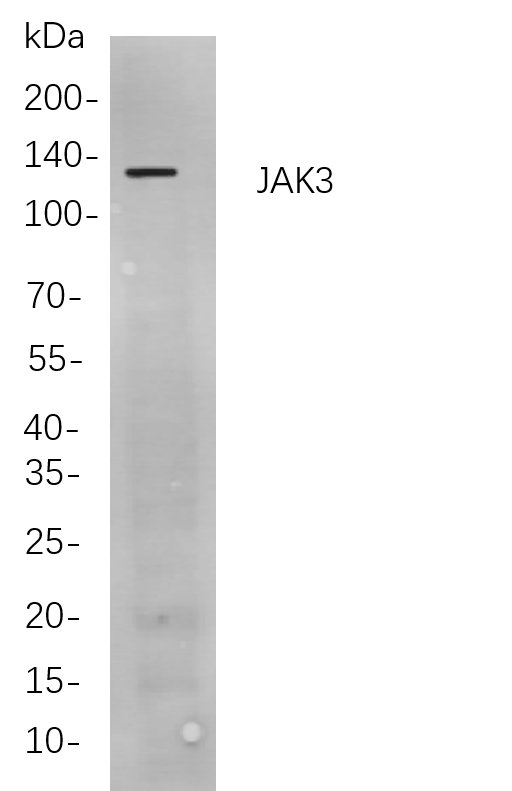
| 参考分子量 | 125kDa |
| 预测分子量 | 125kDa |
| 运输及保存条件 | Biological ice bag transportation. Store at -20°C for at least 12 months(Do not lower than -25°C). Avoid freeze/thaw cycles |
| 宿主 | Rabbit |
| 同种型 | Monoclonal, rabbit, IgG, Kappa |
| 背景介绍 | The protein encoded by this gene is a member of the Janus kinase (JAK) family of tyrosine kinases involved in cytokine receptor-mediated intracellular signal transduction. It is predominantly expressed in immune cells and transduces a signal in response to its activation via tyrosine phosphorylation by interleukin receptors. Mutations in this gene are associated with autosomal SCID (severe combined immunodeficiency disease). [provided by RefSeq, Jul 2008], |
| 信号通路 | Chemokine;Jak_STAT;Primary immunodeficiency; |
| 功能 | catalytic activity:ATP + a [protein]-L-tyrosine = ADP + a [protein]-L-tyrosine phosphate.,disease:Defects in JAK3 are a cause of severe combined immunodeficiency autosomal recessive T-cell-negative/B-cell-positive/NK-cell-negative (T(-)B(+)NK(-)SCID) [MIM:600802]. SCID refers to a genetically and clinically heterogeneous group of rare congenital disorders characterized by impairment of both humoral and cell-mediated immunity, leukopenia, and low or absent antibody levels. Patients with SCID present in infancy with recurrent, persistent infections by opportunistic organisms. The common characteristic of all types of SCID is absence of T-cell-mediated cellular immunity due to a defect in T-cell development.,domain:Possesses two phosphotransferase domains. The second one probably contains the catalytic domain (By similarity), while the presence of slight differences suggest a different role for domain 1.,function:Tyrosine kinase of the non-receptor type, involved in the interleukin-2 and interleukin-4 signaling pathway. Phosphorylates STAT6, IRS1, IRS2 and PI3K.,online information:JAK3 mutation db,PTM:Tyrosine phosphorylated in response to IL-2 and IL-4.,similarity:Belongs to the protein kinase superfamily. Tyr protein kinase family. JAK subfamily.,similarity:Contains 1 FERM domain.,similarity:Contains 1 protein kinase domain.,similarity:Contains 1 SH2 domain.,subcellular location:Wholly intracellular, possibly membrane associated.,subunit:Interacts with STAM2 and MYO18A (By similarity). Interacts with SHB.,tissue specificity:In NK cells and an NK-like cell line but not in resting T-cells or in other tissues. The S-form is more commonly seen in hematopoietic lines, whereas the B- and M-forms are detected in cells both of hematopoietic and epithelial origins., |
| 纯化 | Protein A |
| Clonality | Monoclonal |


周一至周日 8:00-18:00