

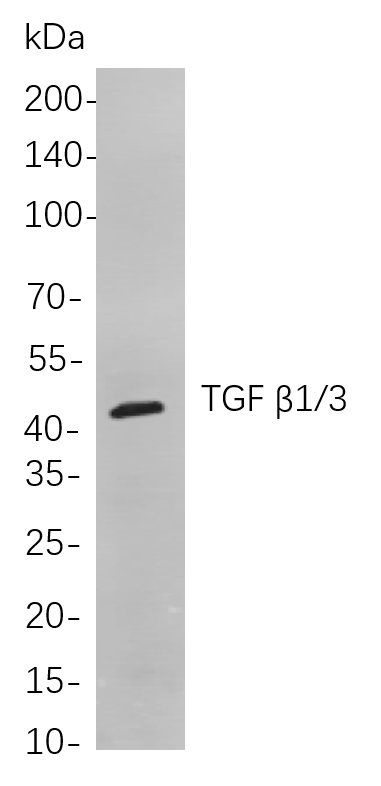
货号:BSB8105
Transforming growth factor beta-1 proprotein;Latency-associated peptide(LAP);Transforming growth factor beta-1(TGF-beta-1);Transforming growth factor beta-3 proprotein;Transforming growth factor beta-3 (TGF-beta-3);TGFB3
| 别名 | Transforming growth factor beta-1 proprotein;Latency-associated peptide(LAP);Transforming growth factor beta-1(TGF-beta-1);Transforming growth factor beta-3 proprotein;Transforming growth factor beta-3 (TGF-beta-3);TGFB3 |
| 基因名称 | TGFB1 |
| 蛋白名称 | Transforming growth factor beta-1 proprotein;Latency-associated peptide(LAP);Transforming growth factor beta-1(TGF-beta-1);Transforming growth factor beta-3 proprotein;Transforming growth factor beta-3 (TGF-beta-3); |
| 推荐应用 | |
| 反应物种 | Human,Mouse,Rat |
| 存储缓冲液 | PBS, 50% glycerol, 0.05% Proclin 300, 0.05%BSA |
| Human Gene Link | http://www.ncbi.nlm.nih.gov/sites/entrez?db=gene&term=7040 |
| Human Swissprot No. | P01137;P10600 |
| Human Swissprot Link | https://www.uniprot.org/uniprotkb/P01137/entry |
| Mouse Gene ID | 21803 |
| Mouse Gene Link | http://www.ncbi.nlm.nih.gov/sites/entrez?db=gene&term=21803 |
| Mouse Swissprot No. | P04202;P17125 |
| Mouse Swissprot Link | https://www.uniprot.org/uniprotkb/P04202/entry |
| Rat Gene ID | 59086;25717 |
| Rat Gene Link | http://www.ncbi.nlm.nih.gov/sites/entrez?db=gene&term=59086 |
| Rat Swissprot No. | P17246;Q07258 |
| Rat Swissprot Link | https://www.uniprot.org/uniprotkb/P17246/entry |
| 稀释度 | IHC-P 1:1000-1:4000, WB 1:500-1:2000, IF-P/IF-F/IF-ICC 1:200-1:1000, ELISA 1:5000-1:20000 |
| 参考分子量 | 44kDa,13kDa |
| 预测分子量 | 44kDa |
| 运输及保存条件 | Biological ice bag transportation. Store at -20°C for at least 12 months(Do not lower than -25°C). Avoid freeze/thaw cycles |
| 宿主 | Rabbit |
| 同种型 | Monoclonal, rabbit, IgG, Kappa |
| 背景介绍 | This gene encodes a secreted ligand of the TGF-beta (transforming growth factor-beta) superfamily of proteins. Ligands of this family bind various TGF-beta receptors leading to recruitment and activation of SMAD family transcription factors that regulate gene expression. The encoded preproprotein is proteolytically processed to generate a latency-associated peptide (LAP) and a mature peptide, and is found in either a latent form composed of a mature peptide homodimer, a LAP homodimer, and a latent TGF-beta binding protein, or in an active form consisting solely of the mature peptide homodimer. The mature peptide may also form heterodimers with other TGF-beta family members. This protein is involved in embryogenesis and cell differentiation, and may play a role in wound healing. Mutations in this gene are a cause of aortic aneurysms and dissections, as well as familial arrhythmogenic |
| 信号通路 | MAPK_ERK_Growth;MAPK_G_Protein;Cytokine-cytokine receptor interaction;Cell_Cycle_G1S;Cell_Cycle_G2M_DNA;TGF-beta;Intestinal immune network for IgA production;Pathways in cancer;Colorectal cancer;Renal cell carcinoma;Pancreatic cancer;Chronic myeloid leukemia;Hypertrophic cardiomyopathy (HCM);Dilated cardiomyopathy; |
| 功能 | TGF-beta-1 proprotein: Precursor of the Latency-associated peptide (LAP) and TGF-beta-1 chains, which constitute the regulatory and active subunit of TGF-beta-1, respectively.; [Latency-associated peptide]: Required to maintain the TGF-beta-1 chain in a latent state during storage in extracellular matrix . Associates non-covalently with TGF-beta-1 and regulates its activation via interaction with 'milieu molecules', such as LTBP1, LRRC32/GARP and LRRC33/NRROS, that control activation of TGF-beta-1 . Interaction with LRRC33/NRROS regulates activation of TGF-beta-1 in macrophages and microglia (Probable). Interaction with LRRC32/GARP controls activation of TGF-beta-1 on the surface of activated regulatory T-cells (Tregs) . Interaction with integrins (ITGAV:ITGB6 or ITGAV:ITGB8) results in distortion of the Latency-associated peptide chain and subsequent release of the active TGF-beta-1;[TGF-beta-1]: Multifunctional protein that regulates the growth and differentiation of various cell types and is involved in various processes, such as normal development, immune function, microglia function and responses to neurodegeneration (By similarity). Activation into mature form follows different steps: following cleavage of the proprotein in the Golgi apparatus, Latency-associated peptide (LAP) and TGF-beta-1 chains remain non-covalently linked rendering TGF-beta-1 inactive during storage in extracellular matrix . At the same time, LAP chain interacts with 'milieu molecules', such as LTBP1, LRRC32/GARP and LRRC33/NRROS that control activation of TGF-beta-1 and maintain it in a latent state during storage in extracellular milieus . TGF-beta-1 is released from LAP by integrins (ITGAV:ITGB6 or ITGAV:ITGB8): integrin-binding to LAP stabilizes an alternative conformation of the LAP bowtie tail and results in distortion of the LAP chain and subsequent release of the active TGF-beta-1 . Once activated following release of LAP, TGF-beta-1 acts by binding to TGF-beta receptors (TGFBR1 and TGFBR2), which transduce signal . While expressed by many cells types, TGF-beta-1 only has a very localized range of action within cell environment thanks to fine regulation of its activation by Latency-associated peptide chain (LAP) and 'milieu molecules' (By similarity). Plays an important role in bone remodeling: acts as a potent stimulator of osteoblastic bone formation, causing chemotaxis, proliferation and differentiation in committed osteoblasts (By similarity). Can promote either T-helper 17 cells (Th17) or regulatory T-cells (Treg) lineage differentiation in a concentration-dependent manner (By similarity). At high concentrations, leads to FOXP3-mediated suppression of RORC and down-regulation of IL-17 expression, favoring Treg cell development (By similarity). At low concentrations in concert with IL-6 and IL-21, leads to expression of the IL-17 and IL-23 receptors, favoring differentiation to Th17 cells (By similarity). Stimulates sustained production of collagen through the activation of CREB3L1 by regulated intramembrane proteolysis (RIP) . Mediates SMAD2/3 activation by inducing its phosphorylation and subsequent translocation to the nucleus . Positively regulates odontoblastic differentiation in dental papilla cells, via promotion of IPO7-mediated translocation of phosphorylated SMAD2 to the nucleus and subsequent transcription of target genes (By similarity). Can induce epithelial-to-mesenchymal transition (EMT) and cell migration in various cell types .Transforming growth factor beta-3 proprotein: Precursor of the Latency-associated peptide (LAP) andTGF-beta-3 chains, which constitute the regulatory and active subunit of TGF-beta-3, respectively.; [Latency-associated peptide]: Required to maintain theTGF-beta-3 chain in a latent state during storage in extracellular matrix (By similarity). Associates non-covalently with TGF-beta-3 and regulates its activation via interaction with 'milieu molecules', such as LTBP1 and LRRC32/GARP, that control activation of TGF-beta-3 (By similarity). Interaction with integrins results in distortion of the Latency-associated peptide chain and subsequent release of the active TGF-beta-3 (By similarity).; Transforming growth factor beta-3: Multifunctional protein that regulates embryogenesis and cell differentiation and is required in various processes such as secondary palate development (By similarity). Activation into mature form follows different steps: following cleavage of the proprotein in the Golgi apparatus, Latency-associated peptide (LAP) andTGF-beta-3 chains remain non-covalently linked rendering TGF-beta-3 inactive during storage in extracellular matrix (By similarity). At the same time, LAP chain interacts with 'milieu molecules', such as LTBP1 and LRRC32/GARP that control activation of TGF-beta-3 and maintain it in a latent state during storage in extracellular milieus (By similarity). TGF-beta-3 is released from LAP by integrins: integrin-binding results in distortion of the LAP chain and subsequent release of the active TGF-beta-3 (By similarity). Once activated following release of LAP, TGF-beta-3 acts by binding to TGF-beta receptors (TGFBR1 and TGFBR2), which transduce signal (By similarity). |
| 纯化 | Protein A |
| Clonality | Monoclonal |


周一至周日 8:00-18:00
