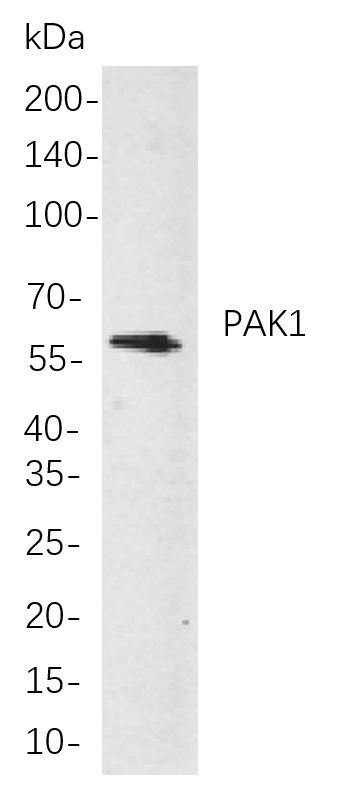
| 别名 | PAK1;Serine/threonine-protein kinase PAK 1;Alpha-PAK;p21-activated kinase 1;PAK-1;p65-PAK |
| 基因名称 | PAK1 |
| 蛋白名称 | Serine/threonine-protein kinase PAK 1 |
| 推荐应用 | |
| 反应物种 | Human,Mouse,Rat |
| 存储缓冲液 | PBS, 50% glycerol, 0.05% Proclin 300, 0.05%BSA |
| Human Gene Link | http://www.ncbi.nlm.nih.gov/sites/entrez?db=gene&term=5058 |
| Human Swissprot No. | Q13153 |
| Human Swissprot Link | http://www.uniprot.org/uniprotkb/Q13153/entry |
| Mouse Swissprot No. | O88643 |
| Mouse Swissprot Link | http://www.uniprot.org/uniprot/O88643 |
| Rat Gene ID | 29431 |
| Rat Gene Link | http://www.ncbi.nlm.nih.gov/sites/entrez?db=gene&term=29431 |
| Rat Swissprot No. | P35465 |
| Rat Swissprot Link | http://www.uniprot.org/uniprot/P35465 |
| 稀释度 | IHC-P 1:200-1:1000, WB 1:1000-1:5000, IF-P/IF-F/IF-ICC 1:200-1:1000, ELISA 1:5000-1:20000, IP 1:50-1:200 |
| 参考分子量 | 61kDa |
| 预测分子量 | 61kDa |
| 运输及保存条件 | Biological ice bag transportation. Store at -20°C for at least 12 months(Do not lower than -25°C). Avoid freeze/thaw cycles |
| 宿主 | Rabbit |
| 同种型 | Monoclonal, rabbit, IgG, Kappa |
| 背景介绍 | This gene encodes a family member of serine/threonine p21-activating kinases, known as PAK proteins. These proteins are critical effectors that link RhoGTPases to cytoskeleton reorganization and nuclear signaling, and they serve as targets for the small GTP binding proteins Cdc42 and Rac. This specific family member regulates cell motility and morphology. Alternatively spliced transcript variants encoding different isoforms have been found for this gene. [provided by RefSeq, Apr 2010], |
| 信号通路 | MAPK_ERK_Growth;MAPK_G_Protein;ErbB_HER;Chemokine;Axon guidance;Focal adhesion;Natural killer cell mediated cytotoxicity;T_Cell_Receptor;Fc gamma R-mediated phagocytosis;Regulates Actin and Cytoskeleton;Epithelial cell signaling in Helicobacter pylori infection;Renal cell carcinoma; |
| 功能 | catalytic activity:ATP + a protein = ADP + a phosphoprotein.,cofactor:Magnesium.,enzyme regulation:Activated by binding small G proteins. Binding of GTP-bound CDC42 or RAC1 to the autoregulatory region releases monomers from the autoinhibited dimer, enables phosphorylation of Thr-423 and allows the kinase domain to adopt an active structure. Also activated by binding to GTP-bound CDC42, independent of the phosphorylation state of Thr-423. Phosphorylation of Thr-84 by OXSR1 inhibits this activation.,function:The activated kinase acts on a variety of targets. Likely to be the GTPase effector that links the Rho-related GTPases to the JNK MAP kinase pathway. Activated by CDC42 and RAC1. Involved in dissolution of stress fibers and reorganization of focal complexes. Involved in regulation of microtubule biogenesis through phosphorylation of TBCB. Activity is inhibited in cells undergoing apoptosis, potentially due to binding of CDC2L1 and CDC2L2.,PTM:Autophosphorylated when activated by CDC42/p21 and RAC1.,similarity:Belongs to the protein kinase superfamily. STE Ser/Thr protein kinase family. STE20 subfamily.,similarity:Contains 1 CRIB domain.,similarity:Contains 1 protein kinase domain.,subcellular location:Recruited to focal adhesions upon activation.,subunit:Homodimer in its autoinhibited state. Active as monomer. Interacts tightly with GTP-bound but not GDP-bound CDC42/P21 and RAC1. Binds to the caspase-cleaved p110 isoform of CDC2L1 and CDC2L2, p110C, but not the full-length proteins. Component of cytoplasmic complexes, which also contain PXN, ARHGEF6 and GIT1. Interacts with ARHGEF7. Also interacts with CRIPAK. Interacts with NISCH., |
| 纯化 | Protein A |
| Clonality | Monoclonal |


周一至周日 8:00-18:00