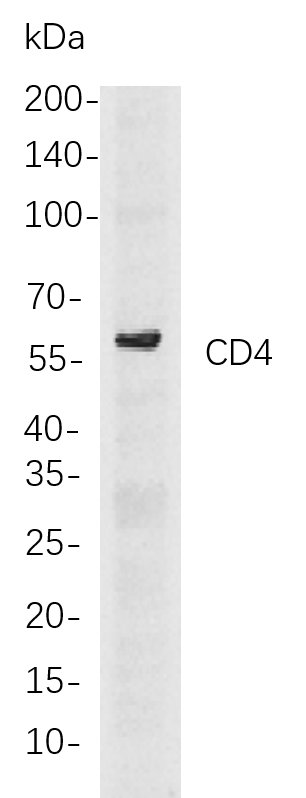
| 别名 | T-cell surface glycoprotein CD4 (T-cell surface antigen T4/Leu-3) (CD antigen CD4) |
| 基因名称 | CD4 |
| 蛋白名称 | T-cell surface glycoprotein CD4 (T-cell surface antigen T4/Leu-3) (CD antigen CD4) |
| 推荐应用 | |
| 反应物种 | Human |
| 存储缓冲液 | PBS, 50% glycerol, 0.05% Proclin 300, 0.05%BSA |
| Human Gene Link | http://www.ncbi.nlm.nih.gov/sites/entrez?db=gene&term=920 |
| Human Swissprot No. | P01730 |
| Human Swissprot Link | https://www.uniprot.org/uniprot/P01730 |
| Mouse Gene ID | 12504 |
| Mouse Gene Link | http://www.ncbi.nlm.nih.gov/sites/entrez?db=gene&term=12504 |
| Mouse Swissprot No. | P06332 |
| Mouse Swissprot Link | https://www.uniprot.org/uniprotkb/P06332/entry |
| Rat Gene ID | 24932 |
| Rat Gene Link | http://www.ncbi.nlm.nih.gov/sites/entrez?db=gene&term=24932 |
| Rat Swissprot No. | P05540 |
| Rat Swissprot Link | https://www.uniprot.org/uniprotkb/P05540/entry |
| 稀释度 | IHC-P 1:1000-1:5000, WB 1:1000-1:5000, IF-P/IF-F/IF-ICC 1:200-1:1000, ELISA 1:5000-1:20000 |
| 参考分子量 | 55kDa |
| 预测分子量 | 51kDa |
| 运输及保存条件 | Biological ice bag transportation. Store at -20°C for at least 12 months(Do not lower than -25°C). Avoid freeze/thaw cycles |
| 宿主 | Rabbit |
| 同种型 | Monoclonal, rabbit, IgG, Kappa |
| 背景介绍 | CD4 molecule(CD4) Homo sapiens This gene encodes a membrane glycoprotein of T lymphocytes that interacts with major histocompatibility complex class II antigenes and is also a receptor for the human immunodeficiency virus. This gene is expressed not only in T lymphocytes, but also in B cells, macrophages, and granulocytes. It is also expressed in specific regions of the brain. The protein functions to initiate or augment the early phase of T-cell activation, and may function as an important mediator of indirect neuronal damage in infectious and immune-mediated diseases of the central nervous system. Multiple alternatively spliced transcript variants encoding different isoforms have been identified in this gene. [provided by RefSeq, Aug 2010], |
| 功能 | Integral membrane glycoprotein that plays an essential role in the immune response and serves multiple functions in responses against both external and internal offenses. In T-cells, functions primarily as a coreceptor for MHC class II molecule:peptide complex. The antigens presented by class II peptides are derived from extracellular proteins while class I peptides are derived from cytosolic proteins. Interacts simultaneously with the T-cell receptor (TCR) and the MHC class II presented by antigen presenting cells (APCs). In turn, recruits the Src kinase LCK to the vicinity of the TCR-CD3 complex. LCK then initiates different intracellular signaling pathways by phosphorylating various substrates ultimately leading to lymphokine production, motility, adhesion and activation of T-helper cells. In other cells such as macrophages or NK cells, plays a role in differentiation/activation, cytokine expression and cell migration in a TCR/LCK-independent pathway. Participates in the development of T-helper cells in the thymus and triggers the differentiation of monocytes into functional mature macrophages. ; (Microbial infection) Primary receptor for human immunodeficiency virus-1 (HIV-1) . Down-regulated by HIV-1 Vpu . Acts as a receptor for Human Herpes virus 7/HHV-7 . |
| 纯化 | Protein A |
| Clonality | Monoclonal |


周一至周日 8:00-18:00