
| 别名 | Beclin-1 (Coiled-coil myosin-like BCL2-interacting protein) (Protein GT197);GT197 |
| 基因名称 | BECN1 |
| 蛋白名称 | Beclin-1 (Ser15) |
| 推荐应用 | |
| 反应物种 | Human,Mouse,Rat |
| 存储缓冲液 | PBS, 50% glycerol, 0.05% Proclin 300, 0.05%BSA |
| Human Gene Link | http://www.ncbi.nlm.nih.gov/sites/entrez?db=gene&term=8678 |
| Human Swissprot No. | Q14457 |
| Human Swissprot Link | https://www.uniprot.org/uniprotkb/Q14457/entry |
| Mouse Gene ID | 56208 |
| Mouse Gene Link | https://www.uniprot.org/uniprot/56208 |
| Mouse Swissprot No. | O88597 |
| Mouse Swissprot Link | https://www.uniprot.org/uniprotkb/O88597 |
| Rat Gene ID | 114558 |
| Rat Gene Link | https://www.uniprot.org/uniprot/114558 |
| Rat Swissprot No. | Q91XJ1 |
| Rat Swissprot Link | https://www.uniprot.org/uniprotkb/Q91XJ1 |
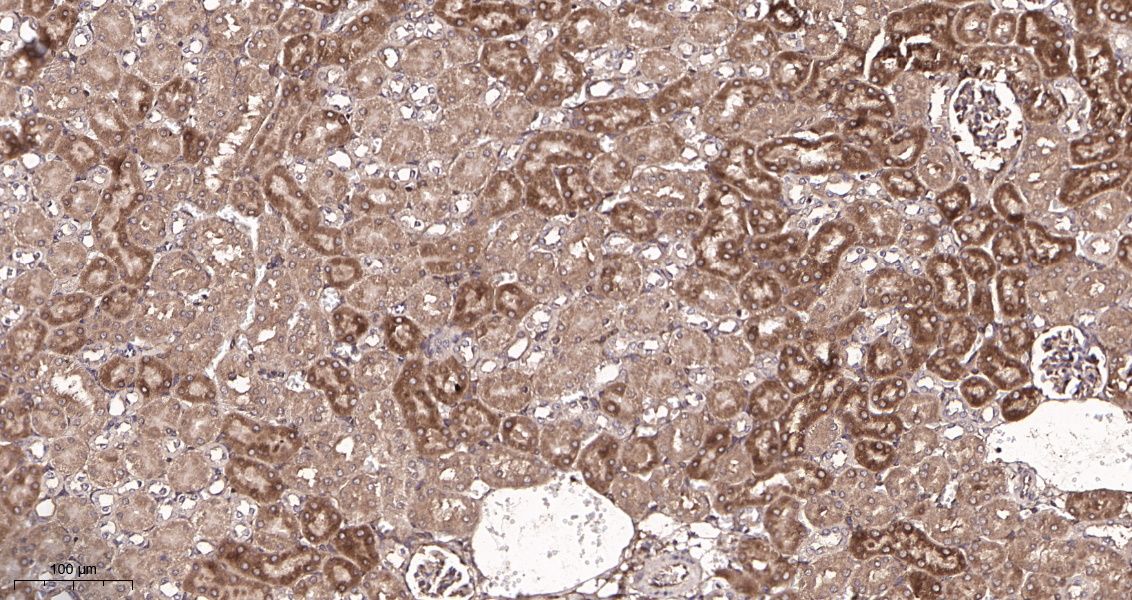
| 稀释度 | IHC-P 1:200-1:1000, WB 1:2000-1:10000, IF-P/IF-F/IF-ICC 1:200-1:1000, ELISA 1:5000-1:20000, IP 1:50-1:200 |
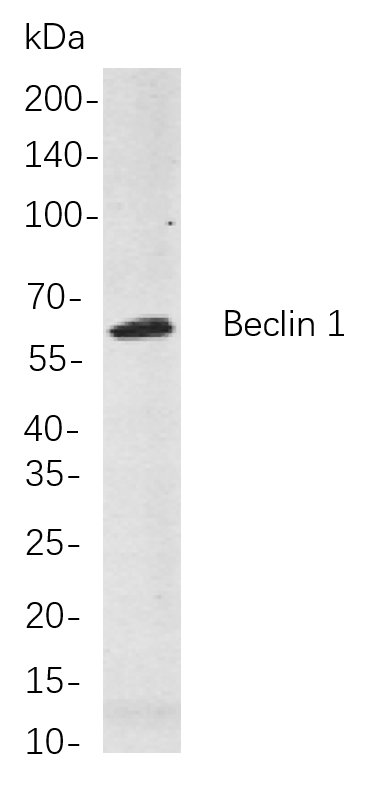
| 参考分子量 | 60kDa |
| 预测分子量 | 52kDa |
| 运输及保存条件 | Biological ice bag transportation. Store at -20°C for at least 12 months(Do not lower than -25°C). Avoid freeze/thaw cycles |
| 宿主 | Rabbit |
| 同种型 | Monoclonal, rabbit, IgG, Kappa |
| 背景介绍 | beclin 1(BECN1) Homo sapiens This gene encodes a protein that regulates autophagy, a catabolic process of degradation induced by starvation. The encoded protein is a component of the phosphatidylinositol-3-kinase (PI3K) complex which mediates vesicle-trafficking processes. This protein is thought to play a role in multiple cellular processes, including tumorigenesis, neurodegeneration and apoptosis. Alternative splicing results in multiple transcript variants. [provided by RefSeq, Sep 2015], |
| 信号通路 | Regulation of autophagy; |
| 功能 | function:Plays a central role in autophagy (By similarity). May play a role in antiviral host defense. Protects against infection by a neurovirulent strain of Sindbis virus.,similarity:Belongs to the beclin family.,subcellular location:Expressed in dendrites and cell bodies of cerebellar Purkinje cells.,subunit:Interacts with GOPC and GRID2. Interacts with AMBRA1. Probably forms a complex with AMBRA1 and PIK3C3 (By similarity). Interacts with BCL2 and BCL2L1.,tissue specificity:Ubiquitous., |
| 纯化 | Protein A |
| Clonality | Monoclonal |


周一至周日 8:00-18:00